What Grade of Stainless Steel Fastener is Right for Your Application?
Selecting the correct grade of stainless steel fasteners is one of the most important decisions you can make in any build or repair. It impacts not only the corrosion resistance of your components, but also their strength, lifespan, total cost of ownership, and ongoing maintenance demands. Fasteners are often the unsung heroes in agriculture, industrial equipment, automotive, marine, and heavy-duty construction — where constant exposure to weather, harsh chemicals, or salt can rapidly degrade the wrong material. By understanding your options, especially among the different grades of stainless steel, you can ensure every joint, anchor, or assembly in your project benefits from high resistance and long-term reliability.
Stainless Steel Fastener Basics
Stainless steel is the go-to solution for many who require fasteners that must perform consistently in challenging conditions. The reason is simple: its unique composition yields several distinct advantages. Stainless fasteners provide superior durability and enhanced corrosion resistance, thanks to the presence of specific alloying elements. Whether your project involves agricultural equipment regularly exposed to fertilizer, or marine structures facing saltwater exposure, stainless steel alloys offer reliable strength with virtually no need for surface coatings or frequent replacements. Moreover, they perform well across a broad temperature range and require minimal maintenance compared to alternatives.
Understanding Stainless Steel Grades
What Does “Stainless Steel Grade” Mean?
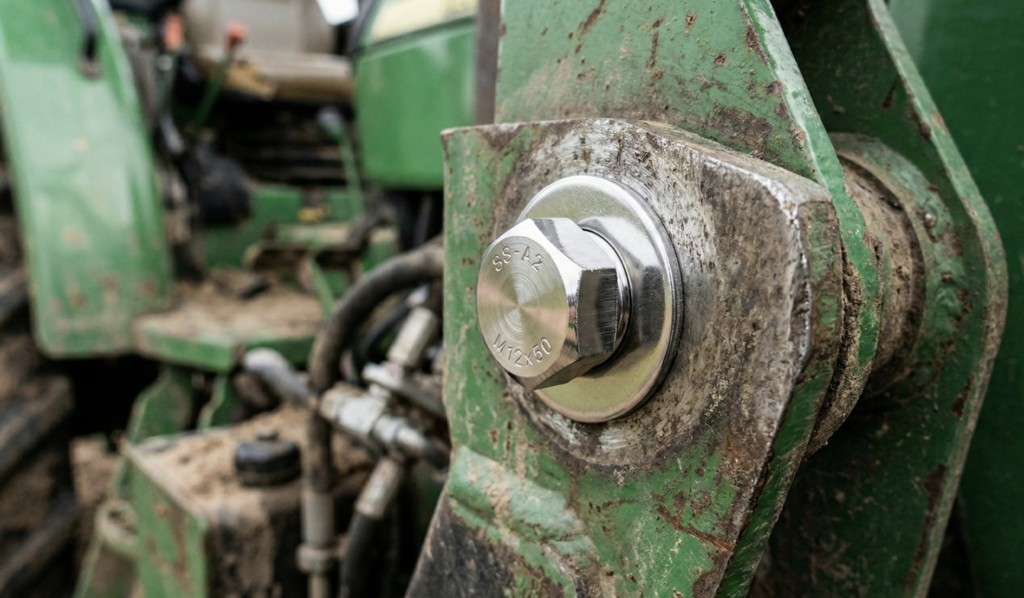
When you come across the term “stainless steel grades,” you’re really looking at the variations in the alloy composition of the steel. Stainless steel is defined by a minimum of 10.5% chromium, an element that reacts with oxygen to create an invisible, corrosion resistant oxide layer. Most stainless steel fasteners also include nickel, which boosts ductility and toughness, while some, like 316, incorporate molybdenum for even greater chemical and salt resistance. Stainless grades are commonly categorized by their alloy series, such as the austenitic stainless steel 300 series, which are the most widely used for fasteners. International standards like ISO refer to these as A2 (similar to 304) and A4 (analogous to 316).
Common Stainless Steel Grades Used in Fasteners
- 18-8 Stainless Steel: The workhorse of general purpose fasteners, this refers to an alloy containing about 18% chromium and 8% nickel, and is functionally similar to 304 stainless steel.
- 304 Stainless Steel: The most common grade, offering strong corrosion resistance at a reasonable cost and widely specified as A2 stainless under ISO.
- 316 Stainless Steel: This alloy contains 2-3% molybdenum, providing excellent chloride and chemical resistance—ideal for saltwater environments and known as A4 in ISO.
- A2 Stainless Steel: The ISO designation commonly used for fasteners, equivalent to 304, suitable for most industrial and commercial environments.
- A4 Stainless Steel: The ISO twin to 316, valued for its superior corrosion resistance, especially in marine and chemical applications.
Key Differences Between Popular Stainless Grades
Chemical Composition
The most important compositional differences among common stainless steel grades come down to their levels of chromium, nickel, and (in the case of 316) molybdenum. Higher chromium means more robust corrosion resistance. Nickel content improves toughness and often yields non magnetic properties, especially after cold working. The addition of molybdenum in 316 or A4 brings enhanced protection against chlorides and certain acids—delivering strong corrosion resistance even in harsh environments.
Corrosion Resistance
Not all stainless steel fasteners are equally equipped to face the elements. 304 (A2) is well-suited to most indoor uses and light outdoor exposure, as well as the food industry, thanks to very good general resistance. However, in the presence of salt spray or aggressive chemicals, 316 stainless steel (A4) outperforms, maintaining integrity even with regular saltwater exposure, fertilizer contact, or harsh chemicals. That’s why marine, coastal, and chemical processing applications specify 316 or its A4 equivalent for their stainless fasteners.
Strength & Mechanical Properties
Austenitic stainless steels used in fasteners—like those in the 18-8 family—offer both high tensile and yield strength, especially if subjected to cold working during manufacturing. These properties permit confident use in load-bearing joints. Grade 316 does lose a touch of strength compared to 304 due to its higher molybdenum content, but the trade-off is the dramatically increased corrosion-resistant performance. Remember, stainless fasteners aren’t usually chosen for maximum strength alone, but for the best balance of mechanical durability and longevity in tough environments.
Cost Considerations
Relative pricing among stainless steel grades reflects their alloying content and the resulting performance. 18-8 and 304/A2 represent the best value for most general uses, offering high resistance at a moderate cost. 316/A4 stainless steel fasteners command a premium—sometimes double the price of 304—but this investment pays off where failure from corrosion would cost far more in equipment downtime or safety risk. Always weigh upfront costs against the value of extended service life and reduced replacements, especially for mission-critical or exposed fasteners.
When to Use Each Stainless Steel Grade
18-8 / 304 Stainless Steel – General Purpose Applications
- Indoor industrial assemblies or plant machinery
- Food processing lines and production equipment
- Agricultural equipment without frequent or intense salt exposure
- Everyday construction, factory build-outs, or mechanical repair
316 Stainless Steel – Marine & High-Corrosion Environments
- Marine docks, boats, or structures in constant contact with saltwater
- Equipment, trucks, or infrastructure exposed to road salt or fertilizers
- Chemical manufacturing, processing tanks, or piping
- Heavy-duty structures where enhanced corrosion resistance is paramount
A2 vs A4: What’s the Difference?
While A2 and A4 are both austenitic stainless steel grades under ISO norms, they serve distinct needs. A2, or 304, is your all-purpose solution in most environments, offering strong corrosion resistance at a moderate price. A4 (316) is specified for extreme environments—marine, chemical plants, or anywhere you require superior resistance to chlorides and acids. For most users, A2 suffices, but choose A4 for maximum protection against harsh chemicals and salt.
Matching Stainless Grades to Fastener Types
Bolts & Hex Cap Screws
Select stainless grades for bolts and hex cap screws based on their working environment:
- For most indoor and protected uses: 18-8 or 304/A2 is suitable, balancing cost, strength, and good corrosion-resistant qualities.
- In high-load or load-bearing outdoor applications subject to chemicals or salt, 316/A4 ensures longevity and ongoing safety.
U-Bolts & Heavy-Duty Fasteners
Structural fasteners like U-bolts must withstand both mechanical load and environmental attack. Here’s what to consider:
- For sheltered frameworks, choose 304/A2 for its high resistance and cost-effectiveness.
- Where the U-bolts or brackets are exposed to corrosive agents or moisture, specify 316/A4 to prevent premature failure and maintain strength over time.
Nuts & Washers
Always match the stainless grade of nuts and washers to their bolts and screws:
- Pairing different grades can accelerate galvanic corrosion, especially in harsh environments. For instance, using a 316 nut with a 304 bolt may cause uneven wear or reduced service life.
- For critical assemblies, especially where salt or chemicals are present, select grade-matched nuts, washers, and bolts for consistent corrosion resistant performance.
Quick Comparison Table: Stainless Steel Fastener Grades
| Grade | Also Known As | Corrosion Resistance | Best For | Relative Cost |
| 18-8 | Basic 300 Series | Good | General indoor & light outdoor use | $ |
| 304 | A2 (ISO) | Very Good | Industrial, food equipment, agriculture | $$ |
| 316 | A4 (ISO, Marine) | Excellent (chloride res.) | Marine, coastal, chemical exposure | $$$ |
How to Choose the Right Grade for Your Application
- What environment will the fastener encounter: constant moisture, agricultural byproducts, or temperature extremes?
- Will there be saltwater, fertilizer, or harsh chemical exposure requiring enhanced corrosion resistance?
- What mechanical strength or load capacity is necessary for your application?
- Is there a budget for initial outfitting versus saved costs on maintenance and replacements?
- Does your project require maximum long-term reliability, either for safety or to minimize downtime?
Choose the Best Stainless Steel Fastener Grade for Lasting Performance
Choosing the correct stainless steel grade for your fasteners isn’t about simply “checking a box”—it’s about making sure your equipment, machinery, or structure delivers the expected performance, safety, and service life in any environment. The right grade not only provides excellent corrosion resistance and strength, but also significantly reduces your ownership costs over time. If you’re unsure which fastener is tailored to your situation, or if you need a custom or bulk solution, BoltCraft stands ready to offer practical guidance and fast, reliable quotes. Count on our expertise and extensive inventory of stainless fasteners—manufactured to the highest quality standards—to ensure your projects are built to last.