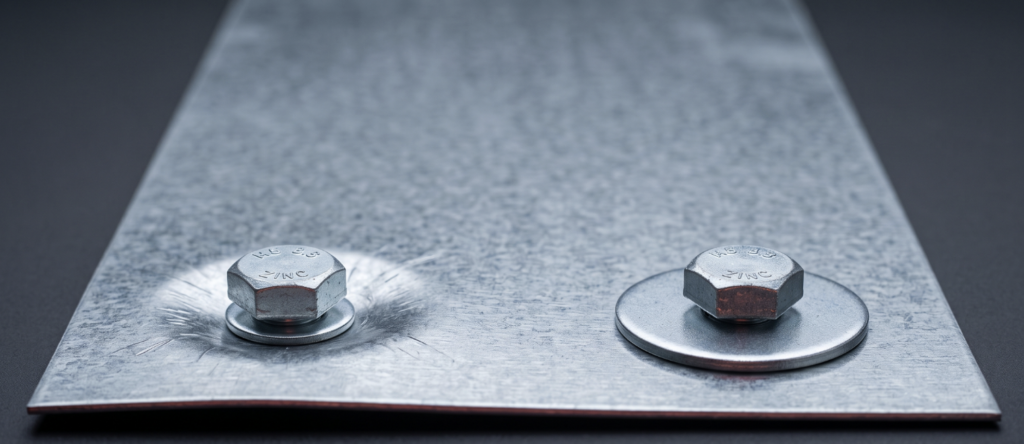
You torque the bolt to spec. The fastener holds. And the panel still dimples around the hole, the sheet cones inward, or the head pulls straight through the material you were trying to secure. The bolt was never the problem. The washer under it was too small to spread the load across enough surface material to keep the joint intact. A fender washer is a flat washer with a much larger outer diameter and a thinner gauge, and the choice between the two comes down to one tradeoff: bearing surface versus clamp load capacity. This guide gives you a spec level rule for which washer belongs in which joint, how to size it, and what happens when you substitute one for the other.
Fender Washer vs Flat Washer: Quick Comparison
Here is the side by side view before we get into why each geometry exists.
| Attribute | Flat Washer | Fender Washer |
| Outer diameter | Modest step up from the clearance hole | Several times the inner hole, far past the hole edge |
| Thickness and gauge | Wide range, from light stampings to heavy structural sections | Thinner gauge metal in most standard sizes |
| Bearing surface | Sized for standard load distribution under a bolt head or nut | Larger bearing surface, sometimes several times the footprint |
| Load and torque capacity | High, and higher still in hardened and structural grades | Moderate, limited by section thickness at the outer edge |
| Hole condition | Standard clearance hole | Oversized hole, slotted hole, worn or enlarged hole |
| Best substrates | Steel plate, cast housings, machined flanges, hard materials | Thin sheet metal, wood, plastic, fiberglass, rubber, aluminum skins |
| Typical specification | SAE and USS dimensional series, ASTM F436 for hardened structural types | Called out by nominal fastener size plus outer diameter and gauge |
| Primary use case | Protecting the mating surface in a joint torqued to a specified preload | Spreading clamp force so a weak substrate or open hole can carry it |
Read the table one way and the tradeoff is simple. Fender washers buy you surface area. Flat washers buy you strength under the head. Everything below is about knowing which one your joint is actually short on.
What Is a Flat Washer?
A flat washer is the general purpose ring that sits between a fastener head or nut and the joint surface, and it does three jobs at once. It distributes clamp load across the mating surface instead of concentrating it on the small footprint of the head. It protects that surface from being gouged as the head rotates during tightening, which matters on painted, plated, and machined faces. And it creates a consistent bearing face, so your torque readings translate into repeatable preload. Because flat washers are produced across a much wider thickness and hardness range than fender washers, they are the type that carries the load in structural and high torque joints.
SAE vs USS Flat Washers
Two dimensional series cover most of what you will buy in inch sized hardware. SAE flat washers run a smaller outer diameter and a lighter section, which suits automotive assemblies, machinery, and any joint where clearance around the fastener is tight. USS flat washers run a larger outer diameter and a heavier section, sized for construction applications and general industrial work. Worth checking before you jump to a fender washer: USS already gives you meaningfully more bearing surface than SAE at the same bolt size, and plenty of joints only need the next series up.
Hardened and Structural Flat Washers
Through hardened and structural flat washers exist because hardness matters as much as footprint once preload gets high. Put an unhardened washer under a Grade 8 or structural bolt and the head embosses itself into the washer face, the washer yields locally, and the joint loses preload as that deformation settles in. Hardened washers resist embedment so the tension you installed stays in the bolt. This also settles most substitution arguments, because there is no fender washer equivalent for a hardened application. If the drawing calls for a hardened washer, a wide thin disc does not satisfy it.
Where Flat Washers Perform Best
Use a flat washer when the joint has a standard clearance hole, when the mating surface is hard enough to carry concentrated pressure, when the assembly is torqued to a specified preload, and when the washer must resist embedment under a high strength head. Steel plate, cast housings, and machined flanges all qualify.
What Is a Fender Washer?
A fender washer is a flat washer whose outer diameter is far larger than its inner diameter, punched from thinner gauge material. Buyers describe it exactly right when they call it a small hole in a big disc. That geometry exists for one reason, which is to move clamp force outward across a wide footprint instead of letting it pile up in a ring around the fastener. Fender washers are what you reach for when the material under the bolt cannot survive the pressure a standard washer puts on it, or when there is not enough material left around the hole to bear against.
Why They Are Called Fender Washers
The name comes from automotive body work. Mounting hardware through a fender or a quarter panel meant clamping down on metal thin enough to tear under a normal bolt head, and the oversized disc solved it by spreading load across the panel instead of into a single ring. The application named the part, and the design intent is right there in the name.
The Diameter and Gauge Tradeoff
Here is the part most comparisons skip. A fender washer wins surface area and gives up section thickness to get it, which is a deliberate design tradeoff rather than a defect. A wide, thin disc will cup, bow, or dish once load concentrates at its center, because there is not enough material through the section to keep the outer edge flat. The practical consequence: a fender washer is not a stand in for a heavier or hardened washer in a high preload joint, no matter how much footprint it adds on paper.
The Core Difference: Bearing Surface and Load Distribution
Bearing surface is the contact area actually carrying clamp force into the joint. Pressure on the surface material is that force divided by the area carrying it, so as the footprint grows, pressure at any point drops. Outer diameter drives that area disproportionately, which is why a modest jump in outer diameter produces a large jump in footprint, and why fender washers deliver better load distribution than standard washers at the same bolt size. Push it too far in either direction and you hit one of two failure modes.
How Bearing Surface Prevents Pull Through and Dimpling
When contact pressure exceeds what the substrate can carry, the substrate gives first. In thin sheet metal the material deforms into a shallow cone around the hole, the fastener seats deeper, preload bleeds off, and the joint either works loose or the head pulls through entirely. In wood and composite panels the washer sinks in and crushes fibers, producing the same loss of tension with no visible bolt failure. Widening the footprint is the direct fix, and it is why fender washers show up wherever thin materials meet threaded fasteners rather than rivets.
Why Thin Gauge Limits Clamp Load
The reverse failure mode is just as common. Under high torque, a wide thin washer flexes upward at the outer edge, contact migrates back toward the inner hole, and the load spreading you specified quietly disappears. You get the pressure concentration of a small washer at the cost of a large one. The working rule: if the joint needs high preload, use a thicker or hardened flat washer, and if it needs coverage, use a fender washer at moderate torque.
When You Need the Bigger Bearing Surface
Four conditions call for a fender washer, and most joints that fail with a standard washer fall into one of them.
Thin Sheet Metal, Panels, and Skins
Sheet metal enclosures, equipment guards and shrouds, truck and trailer body panels, and HVAC ducting share one limitation. The substrate cannot carry concentrated pressure regardless of bolt grade. Upgrading the fastener does nothing here. Widening the washer does.
Oversized, Slotted, or Misaligned Holes
Slotted holes cut for adjustment, holes enlarged during service, and holes that no longer line up after wear are the most common real world reason a fender washer gets specified. The washer bridges the opening so the head bears on sound material instead of hanging over an empty edge, and it covers the cosmetic gap around a repaired or relocated oversized hole.
Soft or Brittle Substrates
Wood, plywood, plastic, fiberglass, composite panels, and rubber isolators fail by crushing and cracking rather than yielding the way steel does. Footprint matters far more than washer hardness here, and a hard washer with a small outer diameter just punches its way in faster.
Repair, Retrofit, and Field Service Work
When a hole cannot be restored and replacing the panel is not on the table, a fender washer is the practical answer. It reestablishes a sound bearing face on material that is already compromised, which is why they ride in most service trucks alongside hex nuts and hex cap screws.
When a Flat Washer Is the Right Choice
Standard flat washers are the correct call in more joints than fender washers are. Use one for standard clearance holes in steel, for any joint that has to reach and hold a specified preload, and anywhere a hardened or structural washer is explicitly called out. Use one when clearance around the fastener will not physically accept a wide disc, which is common near flanges, weld beads, and adjacent components. Use one when the washer sits between two metal surfaces that can both carry the pressure, since there is nothing to gain by spreading the load further. Flat washers are also the default whenever the joint gets torqued to spec and verified, because their dimensional and hardness control is better defined across suppliers.
Sizing and Specification Guide
Four dimensions decide whether a washer performs the way you intended. Get these right and the rest of the joint behaves predictably.
Matching Inner Diameter to Fastener Size
Fender washers are called out by nominal fastener size together with outer diameter, for example a 1/4 in fender washer with a 1 1/4 in outer diameter. The inner hole should clear the shank without excessive slop, because a loose fit lets the washer shift off center under tightening. That pulls part of the footprint off the material you were trying to protect.
Selecting Outer Diameter for the Load
Work from the weakest material in the joint rather than from the bolt. Estimate how much footprint keeps pressure below what that material tolerates, then size outer diameter up from there with margin. For an oversized hole, the washer should extend well past the hole edge onto sound material rather than barely overlapping it, since a sliver of overlap just relocates the failure to a new edge.
Thickness and Gauge
Fender washers are commonly supplied in thinner gauges, while flat washers span everything from light stampings to extra heavy SAE sections. Specify thickness explicitly whenever the application involves meaningful torque. Gauge varies by supplier and finish, and a nominal size call out will not stop you from receiving something lighter than the joint needs.
Stack Ups and Combining Washers
A useful field practice pairs a fender washer against the soft material with a standard or hardened flat washer directly under the fastener head. The hardened washer absorbs the concentrated load from the head and stays flat, and the fender washer spreads that force into the substrate. What not to do is stack several thin standard washers in place of one correctly specified washer. Every added interface can shift or settle, so the stack gives you preload loss instead of additional support.
Material and Finish Selection
Geometry solves the load problem. Material and finish solve the environment problem, and the two decisions are independent.
Carbon Steel with Zinc, Galvanized, or Plain Finish
Zinc coated washers give you cost effective corrosion resistance for indoor service and light exterior exposure, and they are the volume default. Hot dip galvanizing suits sustained outdoor exposure, treated lumber, and agricultural equipment. Plain finish makes sense where the assembly gets painted or powder coated after fastening, since the coating provides the protection.
Stainless Steel Options
304 stainless steel covers general corrosion resistance in wet environments and washdown areas. 316 stainless steel is the step up for chloride heavy, marine, and chemical service where 304 will eventually pit. Stainless also gets specified for appearance on exposed body panels, where a visible washer is part of the finished look.
Matching Washer Finish to the Fastener
Dissimilar metals and finishes in contact inside a wet joint set up galvanic corrosion at the interface, and the less noble material sacrifices itself to protect the other. That shows up as a corroded washer under a perfectly good bolt. Match washer material and finish to the bolt and nut whenever the joint sees moisture, and keep plated washers out of otherwise stainless assemblies in corrosive environments.
Common Mistakes When Substituting One for the Other
- Dropping a fender washer into a high preload structural joint. The washer dishes and preload falls off after the first load cycle.
- Using a fender washer under a hardened bolt head with no hardened washer above it. The head embeds into the thin section and tension escapes without the nut ever loosening.
- Choosing outer diameter by appearance instead of substrate strength. A washer that looks generous can still exceed what plywood tolerates.
- Ignoring clearance. A washer that overhangs a panel edge or fouls an adjacent feature cannot seat flat, so part of the footprint carries nothing.
- Mixing finishes across the joint. Galvanic attack at the washer interface turns a corrosion resistant assembly into a maintenance item.
- Treating a fender washer as a lock washer. Footprint does nothing about vibration. That is a job for a split lock washer, a conical washer, or a prevailing torque nut.
Application Examples by Industry
Agricultural OEM assemblies. Sheet metal shields, hopper panels, and adjustable slotted brackets on planters and implements use fender washers, usually zinc or galvanized because the equipment sits outdoors. The frame bolting underneath those panels uses hardened flat washers with square bend U-bolts and Grade 8 hardware.
Truck, trailer, and vehicle upfit work. Thin skins on box bodies, toolboxes, and accessory mounting plates need the wide footprint, especially where holes get drilled in the field and never land exactly on center. Fender washers also absorb the misalignment that comes with bolting an aftermarket bracket to an existing frame rail.
Heavy construction equipment. Hardened flat washers carry structural bolting at pins, plates, and mounting bosses, while fender washers handle guards, access covers, and belly pans in lighter gauge material. Both types live on the same machine doing different jobs.
Automotive body and repair. The original application still holds. Panel mounting, bracket relocation, license plate and sign hardware, and any repair where a hole has grown all call for the larger disc.
Sourcing Fender and Flat Washers for Production Volume
Selection is one problem. Keeping the line running is another. At production volume, what costs you money is dimensional inconsistency across lots, the wrong finish specified, availability in carton and pallet quantities, and lead time you cannot plan around. A washer is a low cost part right up until it is the part holding an assembly line still. Non standard outer diameters, thicknesses, and inner diameters come up constantly in OEM work, and those are available as custom manufactured parts rather than a stocked size forced to fit.
Custom Washers When a Standard Size Will Not Work
BoltCraft manufactures washers to your outer diameter, inner diameter, thickness, material, and finish when the catalog size is not the right answer, alongside our standard washer, flange bolt, and plow bolt lines. As an independent, family owned manufacturer, we back that with precision manufacturing, quick quote turnaround, flexible stock and release programs, bulk pricing, and a 100% OEM satisfaction guarantee. Send us the dimensions and the application. Request a quote to get started.
Frequently Asked Questions
What is the difference between a fender washer and a flat washer?
A fender washer has a much larger outer diameter than a standard flat washer of the same bolt size, and it is usually made from thinner gauge metal, so it spreads clamp force across a wider bearing surface. Flat washers come in heavier and hardened sections, so they handle higher preload over a smaller area.
Can I use a fender washer instead of a flat washer?
Yes, in joints with moderate torque and a substrate that benefits from the extra footprint. Do not substitute one where a specified preload or a hardened washer is called out, because the thin section will deform and let tension escape. When in doubt, pair the fender washer with a standard flat washer under the head instead of swapping outright.
Are fender washers as strong as flat washers?
No. Fender washers carry less clamp load than flat washers of equal bolt size because their section is thinner, and wide thin discs flex at the outer edge under concentrated force. They win on load distribution, not on strength.
What size fender washer do I need for a 1/4 in bolt?
A 1/4 in fender washer with a 1 1/4 in outer diameter is the common pairing, and larger outer diameters are available when the substrate or hole demands more coverage. Size outer diameter from the weakest material in the joint rather than from the bolt, and confirm the inner diameter clears the shank without letting the washer wander off center.
Why are they called fender washers?
The name comes from automotive body work, where these washers fastened hardware through thin fenders and other body panels without crushing or tearing the sheet. Spreading load across the panel was the whole point of the oversized disc, and the application stuck to the part.
Should I use a fender washer with a lock washer?
You can, and the order matters. Place the fender washer against the substrate, then the lock washer, then the nut, so the locking element bears on a firm flat surface rather than digging into thin material. Lock washers manage vibration and fender washers manage pressure, so both often belong in the same stack.
Are stainless steel fender washers worth the cost?
They are worth it in wet, coastal, chemical, or washdown service, and on exposed panels where appearance matters. In dry indoor assemblies, zinc coated carbon steel gives adequate corrosion resistance at lower cost. The deciding factors are the service environment and whether the rest of the joint is already stainless.
Can fender washers be used in structural applications?
No, not where a structural or hardened washer is specified. Structural bolting relies on the washer resisting embedment at high preload, and a wide thin disc cannot do that. Use an ASTM F436 hardened washer there and keep fender washers for guards, covers, panels, and repair work.
Choosing the Right Washer for the Joint
The decision comes down to one line: use a fender washer when the substrate or the hole cannot carry concentrated load, and use a flat washer when the joint needs preload and the washer needs strength under the head. The washer is a designed component in that joint, not a filler part from a bin, and specifying it correctly keeps preload where your engineer put it. For standard flat washers, fender washers, and custom sizes in production volume, contact us about what your application needs.