A washer is one of the smallest parts in any bolted connection, yet the wrong one can undermine the whole joint. If you have ever grabbed a washer off the shelf and noticed it did not sit flush against the bolt head or nut, you have likely run into the difference between the two main flat washer standards used across the US: SAE and USS. Both are common, both look similar at a glance, and both are essential to a secure, long lasting assembly, but they are not interchangeable. Reach for the wrong one on a fastener with a specific application in mind, and you risk a joint that loosens under load, a washer that crushes the surface it was meant to protect, or a fit that never seats correctly in the first place. This guide explains what each standard is, how SAE and USS washers differ in size and application, and how to pick the correct washer for your bolt and load.
SAE and USS Washer Size Comparison Chart
Before getting into definitions, here is a quick reference. The chart below lists common bolt sizes and their corresponding SAE and USS flat washer dimensions, covering inside diameter, outside diameter, and thickness in inches. Use it to check a size at a glance, or keep reading for the full breakdown of when each standard applies.
| Bolt Size | USS Flat Washer (in) | SAE Flat Washer (in) | ||||
|---|---|---|---|---|---|---|
| Inside Diameter | Outside Diameter | Thickness | Inside Diameter | Outside Diameter | Thickness | |
| #2 | N/A | N/A | N/A | 0.094 | 0.250 | 0.020 |
| #4 | N/A | N/A | N/A | 0.125 | 0.312 | 0.032 |
| #6 | N/A | N/A | N/A | 0.156 | 0.375 | 0.049 |
| #8 | N/A | N/A | N/A | 0.188 | 0.438 | 0.049 |
| #10 | N/A | N/A | N/A | 0.219 | 0.500 | 0.049 |
| #12 | N/A | N/A | N/A | 0.250 | 0.562 | 0.065 |
| 1/4″ | 0.312 | 0.734 | 0.065 | 0.281 | 0.625 | 0.065 |
| 5/16″ | 0.375 | 0.875 | 0.083 | 0.344 | 0.688 | 0.065 |
| 3/8″ | 0.438 | 1.000 | 0.083 | 0.406 | 0.812 | 0.065 |
| 7/16″ | 0.500 | 1.250 | 0.083 | 0.469 | 0.938 | 0.065 |
| 1/2″ | 0.562 | 1.375 | 0.109 | 0.531 | 1.062 | 0.095 |
| 9/16″ | 0.625 | 1.469 | 0.109 | 0.594 | 1.156 | 0.095 |
| 5/8″ | 0.688 | 1.750 | 0.134 | 0.656 | 1.312 | 0.095 |
| 3/4″ | 0.812 | 2.000 | 0.148 | 0.812 | 1.469 | 0.134 |
| 7/8″ | 0.938 | 2.250 | 0.165 | 0.938 | 1.750 | 0.134 |
| 1″ | 1.062 | 2.500 | 0.165 | 1.062 | 2.000 | 0.134 |
| 1 1/8″ | 1.250 | 2.750 | 0.165 | N/A | N/A | N/A |
| 1 1/4″ | 1.375 | 3.000 | 0.165 | N/A | N/A | N/A |
| 1 3/8″ | 1.500 | 3.250 | 0.180 | N/A | N/A | N/A |
| 1 1/2″ | 1.625 | 3.500 | 0.180 | N/A | N/A | N/A |
| 2″ | 2.125 | 4.500 | 0.213 | N/A | N/A | N/A |
Notice how the outside diameter and thickness for USS washers keep climbing beyond bolt sizes where SAE washers stop being commercially defined. That gap is not an accident. SAE bolts in the smaller and mid size range are common in automotive and machinery work, while bolts above roughly 1 inch move into the structural and heavy equipment territory where USS washers dominate.
What Is a Flat Washer and Why Does the Standard Matter?
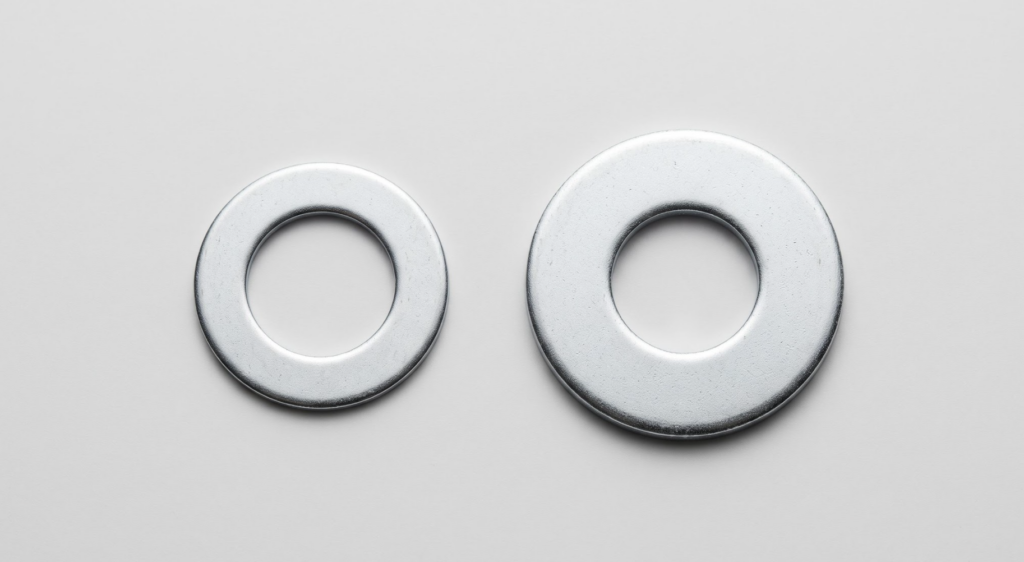
A flat washer is a thin, disk shaped plate with a center hole sized to fit around a bolt or screw. Its job sounds simple: sit between the fastener head (or nut) and the material being joined. In practice, a washer does several things at once. It distributes the clamping force of the bolt across a wider surface, which helps prevent damage to softer materials. It protects the surface from scratching or crushing during tightening. It also helps reduce the chance of the fastener loosening under vibration by creating a more even, stable bearing surface.
Not every flat washer is made to the same dimensions, even for the same size bolt. That is exactly why the SAE and USS standards exist. Each one specifies a different inside diameter, outside diameter, and thickness for a given bolt size, and mixing them up on a job can leave you with a washer that is too tight, too loose, or too thin to distribute load the way the application needs. Getting the standard right is a small detail with a real effect on the strength and reliability of the finished joint.
What Are SAE Flat Washers?
SAE flat washers are made to specifications set by the Society of Automotive Engineers, one of the standards bodies that governs fastener dimensions in the automotive industry. Compared to a USS washer built for the same bolt size, an SAE washer is characterized by a smaller outer diameter, a smaller inner diameter, and a thinner profile. Manufacturing tolerances on SAE washers also tend to be tighter, which is part of why SAE washers are typically used wherever precise fit matters more than maximum surface coverage.
Because of their compact size, SAE washers are sometimes described as the washer of choice when space is limited. Their smaller outer diameter lets them fit into tighter clearance spaces around bolt heads, nuts, and adjacent hardware without interference, something a larger USS washer simply cannot do in the same footprint.
Common Materials and Where SAE Washers Are Used
SAE flat washers are commonly produced in steel, stainless steel, and brass, with many steel washers zinc plated for corrosion resistance. You will find them most often in automotive assemblies, precision machinery, and engine components, especially where the bolts use fine threads. Fine threaded bolts and SAE washers tend to be paired together because both are built around tighter tolerances and closer fits.
In general, SAE washers are considered a solid choice for most everyday applications, from equipment panels to smaller structural connections, wherever available space is limited and load distribution is a secondary concern relative to fit.
What Are USS Flat Washers?
USS stands for United States Standard, a sizing convention that predates and helped inform today’s ANSI standards and has historical roots tied to Navy specifications for fasteners. A USS flat washer built for the same nominal bolt size as an SAE washer will have a larger outer diameter, a larger inner diameter, and noticeably greater thickness. Manufacturing tolerances are also looser on USS washers, which gives them a bit more flexibility to fit slightly oversized or imperfect holes without binding.
That larger footprint is the entire point. A USS washer spreads clamping force over a wider bearing surface, which matters when the base material is softer or when the joint will be exposed to vibration or repeated movement.
Common Materials and Where USS Washers Are Used
Like SAE washers, USS flat washers are available in steel, stainless steel, and other alloys depending on the corrosion resistance and strength the application calls for. USS washers are the go to choice for construction, structural steel connections, and agricultural equipment, where coarse threaded bolts and heavier duty fasteners are the norm. They also perform well against softer base materials such as wood, since the larger bearing surface helps prevent the washer, and the bolt with it, from digging in or crushing the material underneath, in much the same way a wide bodied fender washer spreads load across an even larger area.
USS washers are frequently specified for general construction and framing work, and they are a practical fix when a hole has been drilled oversized or has suffered some wear, since the wider diameter gives the washer more surface to bridge the gap. In high vibration environments, from heavy equipment to outdoor structures exposed to wind and load cycling, the extra surface area and thickness of a USS washer provide a more secure grip and help the connection stay tight over time.
SAE vs USS Washers: Key Differences at a Glance
The core distinctions between SAE and USS washers come down to three things: size, tolerance, and typical use case. SAE washers are smaller in outer and inner diameter, thinner, and manufactured to tighter tolerances, which makes them well suited to precision work and tight clearance spaces. USS washers are larger in every dimension, thicker, and built to looser tolerances, which makes them better suited to heavier loads, softer materials, and situations where a wider load distribution matters more than a snug fit.
Neither standard is universally “better.” As the comparison chart above shows, the right one depends entirely on your bolt, your material, and the forces the joint needs to handle.
How to Choose the Right Washer for Your Bolt and Load
Picking between SAE and USS is not just a rule of thumb about industry, it is a decision that should account for a handful of specific factors every time.
Start with bolt size and thread type. A fine threaded bolt is a strong signal that an SAE washer will fit the assembly’s intended tolerances. A coarse threaded bolt points toward USS. Next, consider the material you are fastening into. Hard, precise components like machined metal parts pair naturally with the tighter fit of SAE washers. Softer materials such as wood, composite panels, or thinner sheet metal benefit from the wider bearing surface of USS washers, which spreads clamping force instead of concentrating it in one small area.
Also factor in vibration and movement. Equipment that runs continuously, vehicles, or outdoor structures exposed to wind loading all put repeated stress on a bolted joint, and a USS washer’s larger surface area and thickness help the connection resist loosening over time. Finally, weigh required load distribution against available space. If the assembly has tight clearances around the fastener, an SAE washer may be your only option regardless of load, since a USS washer’s larger outer diameter simply will not clear.
It helps to walk through these factors in order rather than guessing based on habit. A washer that looks right at a glance can still be the wrong number once you check the bolt against a size chart, and a joint that seems secure today can loosen months later if the washer was never suited to the vibration or movement the assembly actually experiences. Taking a minute to confirm bolt size, thread type, base material, and expected conditions before you order or install a batch of washers is a small step that protects the integrity of every connection downstream.
When SAE Washers Are the Better Choice
Reach for SAE washers on fine threaded bolts, automotive and machinery assemblies, and any build where tight tolerances and a close fit around the bolt head or nut are part of the design. They are also the practical pick whenever available space around the fastener is limited, since their smaller outer diameter keeps them from interfering with nearby components.
When USS Washers Are the Better Choice
USS washers are the stronger fit for coarse threaded bolts, structural connections, and agricultural equipment that sees heavy use and constant vibration. They also make sense whenever you are fastening into a softer material that needs its load spread over a wider area, or when a hole has been drilled oversized and needs a washer large enough to bridge the extra clearance.
SAE vs USS Washers by Industry: Quick Reference
For agricultural OEM applications, USS washers are usually the default given the coarse threaded bolts, vibration, and outdoor exposure common on farm equipment, though SAE washers still show up on precision components like hydraulic assemblies and control linkages. In general industrial equipment, the choice often splits by subsystem: SAE washers on fine threaded machinery and instrumentation, USS washers on structural frames and heavier mounting hardware.
In the automotive industry, SAE is the default standard across most assemblies, from engine components to body panels, thanks to the fine threaded bolts and tight clearances typical of vehicle design. In heavy duty construction, USS washers are the more common choice given the coarse threaded bolts, structural steel connections, and rough field conditions that call for a wider, more forgiving bearing surface.
Custom and Bulk Washer Options From BoltCraft
BoltCraft supplies both standard SAE and USS flat washers, along with custom sizes, materials, and coatings built to your exact specifications through our custom fastener services. Whether your project calls for a specific outer diameter, an unusual inside diameter, or a coating tailored to your environment, our team can source it. We back every order with quick quote turnaround, flexible stock and release programs so you always have washers on hand without overcommitting inventory, and bulk pricing built for OEM and industrial buyers who need reliable volume. Washers are just one part of the catalog. Browse our bolts and nuts as well to round out a complete, correctly matched fastener assembly.
As an independent, family owned distributor, we treat every order, large or small, custom or catalog, with the same attention to quality and service that has made BoltCraft a trusted partner across agricultural, industrial, automotive, and construction fastener needs.
Frequently Asked Questions About SAE and USS Washers
Can I use an SAE washer in place of a USS washer?
You can in some low load, low vibration situations, but it is generally risky. An SAE washer’s smaller outer diameter means less bearing surface, which can leave gaps around the bolt or fail to distribute load properly against softer or uneven materials. For structural connections, heavy equipment, or anything exposed to repeated vibration, stick with the washer type the application calls for rather than substituting based on what happens to be on hand.
Which washer type is more common?
SAE washers are the more widely used general purpose washer, largely because of how common fine threaded bolts and automotive applications are across manufacturing and repair work. USS washers are reserved for more specific, heavier duty needs where a wider bearing surface and greater thickness are essential to the joint’s integrity.
Do SAE and USS washers use the same materials?
Yes. Both standards are available in steel, stainless steel, and other alloys such as brass. Material selection depends on the application itself, things like corrosion exposure, strength requirements, and the environment the fastener will serve in, not on whether the washer follows the SAE or USS standard.
Get the Right Washer for Your Application
Choosing between SAE and USS flat washers does not have to be a guess. Match the washer to your bolt size, thread type, material, and load conditions, and you will end up with a connection built to last rather than one that just happens to fit. If you are still unsure which washer type, size, or material is right for your specific application, request a quote or contact our team directly. We will help you match the correct washer to your bolt and load requirements, whether you need a handful of standard parts or a bulk order of custom fasteners.