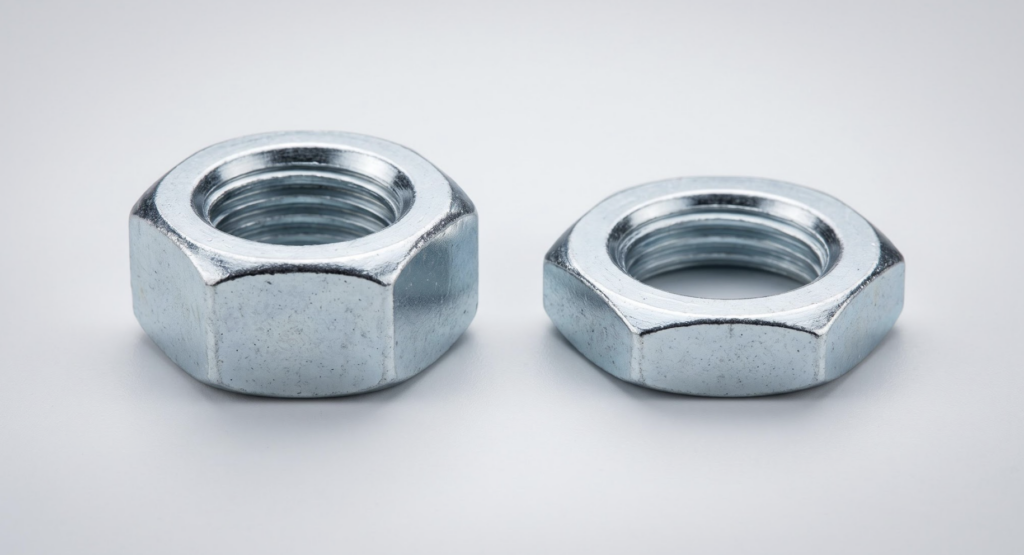
If you have ever picked up two nuts that look almost identical and wondered why one is noticeably thinner, you are not alone. Jam nuts and hex nuts share the same hexagonal shape and the same internal threading, and at a glance they can be mistaken for each other. But they are built for different jobs. One is a primary fastener rated to carry load. The other is a support piece that locks the primary fastener in place. This article breaks down what separates a jam nut from a standard hex nut, walks through the dimensions you should expect on a spec sheet, and shows you the correct way to install a jam nut so it actually does its job.
Hex Nut vs Jam Nut: Quick Comparison
| Feature | Hex Nut | Jam Nut |
|---|---|---|
| Shape | Six equal sides, hexagonal | Six equal sides, hexagonal, same as hex nut |
| Thickness | Full height, standard thickness | Roughly half to two thirds the thickness of a hex nut |
| Structural Rating | Graded and rated for load bearing use | Not a structural fastener, no strength rating |
| Primary Function | Fastens two components together and carries the clamping load | Locks a standard nut in place to prevent it from backing off |
| Placement | Tightened directly against the work surface | Threaded on first, then jammed against the standard nut |
| Typical Use | General purpose fastening for static and load bearing connections | Vibration prone assemblies, threaded rods, and fine position adjustments |
What Is a Hex Nut?
A standard hex nut is the fastener most people picture when they think of a nut. It has six equal sides, internal threading that matches a bolt’s external threads, and it twists onto that bolt until it is snug against the material being joined. Because a hex nut functions as a structural fastener, it is graded for strength and tightened directly against the work surface to hold two components together under load. That grading matters: a Grade 2 hex nut and a Grade 8 hex nut may look identical, but their strength ratings tell you what kind of stress the connection can handle.
What Is a Jam Nut?
A jam nut uses the same hexagonal shape and the same thread pattern as a hex nut, but it is noticeably thinner, typically about half the thickness of a standard hex nut of the same size. That reduced thickness is the whole point. A jam nut is never meant to be used on its own as a load bearing fastener. Its job is to lock against a standard nut so that vibration, repeated movement, or thermal cycling cannot back the main nut off the bolt. Threaded rods and linkages that need fine position adjustments also rely on jam nuts, since a pair of thin nuts can be tightened against each other at almost any point along the thread.
Jam Nut vs Hex Nut: Key Differences
Once you line the two up side by side, the practical differences become easy to spot.
Thickness
A jam nut runs roughly two thirds the thickness of a standard hex nut in the same size, and in some size ranges it measures closer to half. That thinner profile lets it fit into tight spaces where a full height nut simply will not clear.
Structural Rating
Hex nuts are graded and rated for load bearing use, which is why you will see them specified by grade on an engineering drawing. Jam nuts are not structural fasteners and carry no independent strength specification. Fewer threads engage inside a jam nut than inside a full hex nut, so its load capacity is lower by design, not by accident.
Function and Placement
A hex nut fastens directly to the work surface and carries the clamping load of the joint. A jam nut is always paired with a second nut and positioned to lock that nut in place rather than to bear load on its own.
Types of Jam Nuts
Standard Hex Jam Nuts
A standard hex jam nut is the thin nut most commonly used to secure a primary nut on lighter duty applications, general assembly work, and connections that see moderate vibration. It shares the same width across flats and across corners as a standard hex nut, so the same wrench fits both.
Heavy Hex Jam Nuts
Heavy hex jam nuts are thicker than standard jam nuts and pair with heavy hex nuts rather than standard ones. They feature wider flats and larger corners, and they are built for heavy duty or high vibration industrial and agricultural applications where a standard jam nut would not offer enough bearing surface. They are made from high strength ASTM grade steel and are considered ideal for heavy duty applications where added security against loosening is a priority.
Jam Nut Dimensions and Specifications
ANSI/ASME B18.2.2 is the governing standard for hex nuts, hex jam nuts, heavy hex nuts, and heavy hex jam nuts in the inch series, and it defines width across flats, width across corners, and thickness for every size. Standard hex nuts and jam nuts run from 1/4 inch nominal size upward, while heavy hex nuts and heavy hex jam nuts cover a broader range, from 1/4 inch up to 4 inches. Thread pitch does not change the nut body, so a coarse thread and a fine thread nut of the same nominal size share identical outside dimensions.
Standard hex nut and hex jam nut dimensions, in inches:
| Nominal Size | Width Across Flats (basic) | Width Across Corners (max) | Hex Nut Thickness (basic) | Jam Nut Thickness (basic) |
|---|---|---|---|---|
| 1/4 | 7/16 (0.438) | 0.505 | 7/32 (0.219) | 5/32 (0.156) |
| 5/16 | 1/2 (0.500) | 0.577 | 17/64 (0.266) | 3/16 (0.188) |
| 3/8 | 9/16 (0.562) | 0.650 | 21/64 (0.328) | 7/32 (0.219) |
| 7/16 | 11/16 (0.688) | 0.794 | 3/8 (0.375) | 1/4 (0.250) |
| 1/2 | 3/4 (0.750) | 0.866 | 7/16 (0.438) | 5/16 (0.312) |
| 5/8 | 15/16 (0.938) | 1.083 | 35/64 (0.547) | 3/8 (0.375) |
| 3/4 | 1 1/8 (1.125) | 1.299 | 41/64 (0.641) | 27/64 (0.422) |
Heavy hex nut and heavy hex jam nut dimensions, in inches:
| Nominal Size | Width Across Flats (basic) | Width Across Corners (max) | Heavy Hex Nut Thickness (basic) | Heavy Hex Jam Nut Thickness (basic) |
|---|---|---|---|---|
| 1/4 | 1/2 (0.500) | 0.577 | 15/64 (0.234) | 11/64 (0.172) |
| 1/2 | 7/8 (0.875) | 1.010 | 31/64 (0.484) | 19/64 (0.297) |
| 3/4 | 1 1/4 (1.250) | 1.443 | 47/64 (0.734) | 27/64 (0.422) |
| 1 | 1 5/8 (1.625) | 1.876 | 63/64 (0.984) | 35/64 (0.547) |
| 1 1/4 | 2 (2.000) | 2.309 | 1 7/32 (1.219) | 23/32 (0.719) |
| 1 1/2 | 2 3/8 (2.375) | 2.742 | 1 15/32 (1.469) | 27/32 (0.844) |
| 2 | 3 1/8 (3.125) | 3.608 | 1 31/32 (1.969) | 1 3/32 (1.094) |
Jam nuts are commonly stocked in low carbon steel, and stainless options are widely available where corrosion resistance matters more than raw strength. Proof load ratings on jam nuts are typically lower than on the hex nut they pair with, another reminder that a jam nut supports a connection rather than carrying it.
What Are Jam Nuts Used For?
You will find jam nuts anywhere a connection is exposed to vibration or repeated movement. Agricultural equipment is a prime example: implements that shake and jolt across a field all day need every fastener to hold, and a jam nut backing up a standard nut keeps that connection from working loose over a season. Industrial machinery with rotating or reciprocating parts sees the same benefit, as do automotive assemblies where engine and suspension vibration would otherwise walk a nut off its bolt over time. Heavy construction equipment, with its constant impact loading, is another setting where a jam nut earns its place. These are exactly the industries BoltCraft Manufacturing serves, from agricultural OEM programs to industrial, automotive, and heavy duty construction projects, so if your application falls into any of these categories, a jam nut is worth specifying alongside your primary hex nut. For a deeper look at how jam nuts stack up against other anti vibration options, see our comparison of hex nuts, flange nuts, and lock nuts.
How to Use a Jam Nut Correctly
Jam nuts are more sensitive to improper installation and torque than standard hex nuts, and getting the sequence wrong will undo the whole point of adding one.
Correct Installation Order
Thread the jam nut onto the bolt first, so it sits against the work surface. Then thread the standard or heavy hex nut on top of it. Once both nuts are hand tightened, hold the top hex nut steady with one wrench while you tighten the jam nut back up against it with a second wrench, effectively “jamming” the two together. This locks the pair in place and gives you a connection that resists backing off even under sustained vibration.
Common Installation Mistakes
- Installing the jam nut on top of the standard nut instead of underneath it, which reverses the intended clamping action.
- Failing to hold the top nut steady with a second wrench while tightening the jam nut, which can loosen the very connection you are trying to secure.
- Using a jam nut by itself as a load bearing fastener, since it carries no independent strength rating and requires more vertical clearance than the design intends.
- Pairing nuts with mismatched thread pitch, which prevents the two from seating flush against each other and defeats the locking action.
When to Choose a Jam Nut Over a Standard Hex Nut
For a standard static connection with no meaningful vibration or movement, a single hex nut tightened to spec is usually all you need. Add a jam nut when the assembly will see regular vibration, repeated cycling, or any condition where a loosened fastener would create a safety risk or costly downtime. Threaded rods and adjustable linkages are another good case for jam nuts, since they provide mechanical locking without needing adhesives or a separate locking device.
Materials and Finishes
Jam nuts and the hex nuts they pair with are available in carbon steel for general purpose use and in stainless steel where corrosion resistance is the priority. For outdoor and agricultural applications, zinc plating and hot dip galvanizing are the most common finishes, both chosen to extend service life in wet or exposed conditions. Whichever material you choose, keep both nuts in the same finish and grade family so the pair performs consistently as a unit.
Why Source Jam Nuts and Hex Nuts from BoltCraft Manufacturing
BoltCraft Manufacturing supplies a full range of custom and standard fasteners, including standard hex jam nuts and heavy hex jam nuts alongside U bolts, plow bolts, hex cap screws, hex nuts, flange cap screws, and washers. As an independent, family owned fastener distributor, BoltCraft backs every order with quality assurance, quick quote turnaround, and flexible stock and release programs that keep your production line supplied without overstocking your shelves. Every order ships with a 100% OEM satisfaction guarantee and reliable delivery across the USA. If your project calls for jam nuts, hex nuts, or a custom fastener combination, request a quote, browse the full nut catalog, or contact our team to get the exact specification your application needs.
Frequently Asked Questions
Can a jam nut be used by itself?
No. A jam nut is not a structural fastener and carries no independent load rating. It is designed to be tightened against a standard or heavy hex nut, not to bear the clamping load of a joint on its own.
Which nut goes on first, the jam nut or the hex nut?
The jam nut goes on first, seated against the work surface. The standard or heavy hex nut threads on second, and the jam nut is then tightened back up against it to lock the assembly.
Are jam nuts and hex nuts interchangeable?
No. A jam nut is thinner than a hex nut of the same nominal size and carries no strength rating, while a hex nut is graded and built to be tightened directly against the material being fastened. Using one in place of the other compromises either the clamping load or the locking function the assembly needs.
Choosing the Right Nut for the Job
A hex nut and a jam nut share a hexagonal shape and a thread pattern, but that is where the similarity ends. A hex nut is the structural fastener that carries the load of your connection. A jam nut is the thin backup that locks that hex nut in place against vibration and movement. Once you know which one your application calls for, and you follow the correct installation order, you get a connection that stays tight for the long haul. Browse BoltCraft Manufacturing’s fastener catalog or request a quote today to get the right jam nuts and hex nuts for your next project.