When you are specifying a bolt for an OEM assembly, an agricultural implement, or an industrial project, one of the first decisions you face is whether to use a fully threaded bolt or a partially threaded bolt. It looks like a small detail on a drawing, but get it wrong and you can end up with loosening under vibration, shear failure at the joint, or parts that simply will not align the way they should. This guide breaks down the real difference between a full thread bolt and a partial thread bolt, walks through when each one belongs in your application, and gives you the practical knowledge to choose with confidence. As a manufacturer that produces fasteners for agricultural OEM, industrial, automotive, and heavy duty construction customers, BoltCraft approaches this from a production floor perspective, not a general hardware store perspective.
Full Thread Bolt vs Partial Thread Bolt: Quick Comparison
If you need the short answer before reading the full breakdown, here is how the two compare at a glance.
| Full Thread Bolt | Partial Thread Bolt |
| Threading Coverage: Entire length of the shank | Threading Coverage: Partial length, with a smooth grip section below the head |
| Best For: Tension and clamping heavy joints | Best For: Shear heavy and vibration prone joints |
| Shear Resistance: Lower, threads act as weak points under lateral load | Shear Resistance: Higher, smooth shank bears the load |
| Clamping Force: High and evenly distributed | Clamping Force: Strong when grip length matches material stack |
| Alignment Accuracy: Standard | Alignment Accuracy: Superior, smooth shank centers parts precisely |
| Common Applications: Body panels, structural steel, general OEM assemblies | Common Applications: Motor mounts, water pumps, pivot points, axle connections |
What Is a Bolt and How Does Threading Work?
A bolt is an externally threaded fastener designed to pass through pre drilled, unthreaded holes in the parts you are joining, then pair with a nut on the other side to create clamping force. This sets it apart from a screw, which typically threads directly into a tapped hole or forms its own thread as it is driven in. Every bolt shares the same basic anatomy: a head for driving and torque, a shank running down the body, external threading, and a tip. Understanding these parts makes the rest of this comparison much easier to follow.
What Is a Fastener Thread?
A thread is the helical ridge wrapped around the bolt shank that allows it to be tightened into or through a mating surface and removed when needed. Thread pitch refers to the distance between individual threads, while major and minor diameter describe the outer and inner measurements of the threaded section. These fundamentals matter because they set the stage for understanding why the amount of the shank that carries threading, whether it runs the entire length or only part of it, changes how a bolt performs.
What Is a Full Thread Bolt?
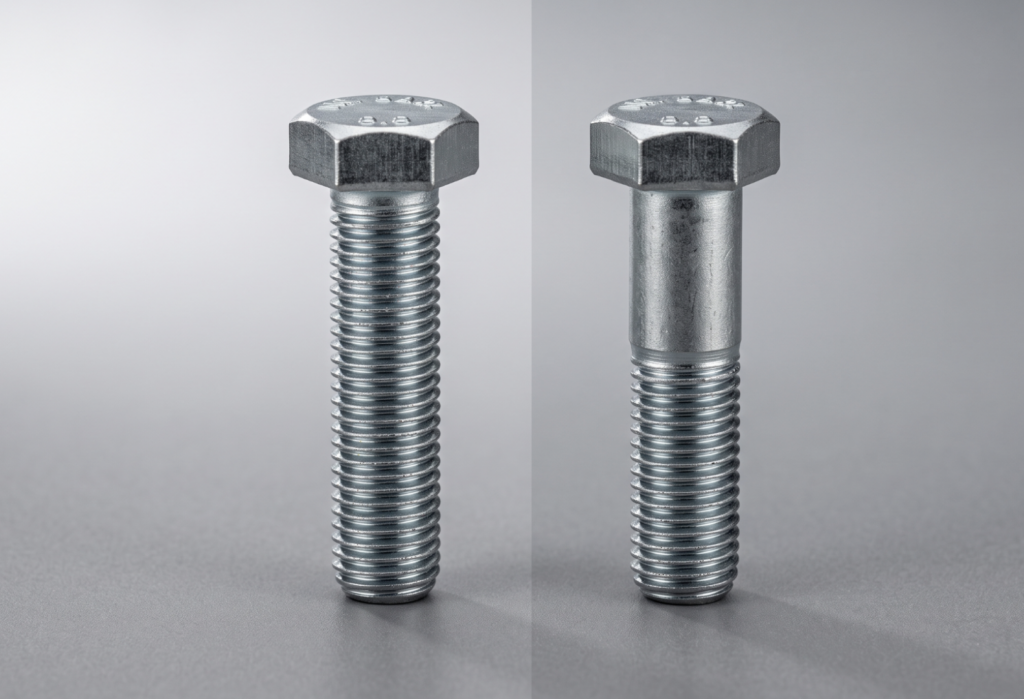
A full thread bolt, also called a fully threaded bolt, has external threading running the entire length of the shank, from directly under the head all the way to the tip. There is no smooth or unthreaded section anywhere along the shaft. Because threading covers the full shank, the entire length of the bolt engages with the nut or a tapped hole, giving you flexibility in where the clamping point sits. Hex tap bolts and threaded rod and studs are two common examples of fully threaded fasteners you will come across in this category.
Key Characteristics of Full Thread Bolts
- Threading runs head to tip with no unthreaded portion anywhere on the shank
- No grip length or shoulder to account for during specification
- Mounting pressure and load distribution are spread evenly across the full length of the bolt
- The nut can be positioned anywhere along the shaft, allowing flexible grip adjustment across varying material thicknesses
- Fewer length variations are typically needed to stock, which simplifies inventory for OEM production runs
What Is a Partial Thread Bolt?
A partial thread bolt, also called a partially threaded bolt, has a smooth, non threaded portion directly beneath the head, known as the grip length or shank, followed by threading for the remaining portion of the bolt. This design exists for a specific reason: it gives the joint a smooth bearing surface that carries shear force, rather than asking the threads themselves to bear that load. Hex cap screws are one of the most common partially threaded fasteners you will spec for this kind of joint.
Key Characteristics of Partial Thread Bolts
- The smooth section resists shear force since there are no thread roots present to create a weak point along that portion of the shank
- Improves alignment accuracy between mated parts, since the smooth shank centers more precisely inside the hole than a threaded surface would
- Well suited to applications where vibration or side loading is a concern
- Grip length has to be matched to the thickness of the material stack for the clamping force to work as intended
Full Thread vs Partial Thread Bolt: The Core Difference
The core distinction comes down to this: full thread bolts are built to maximize grip strength and clamping force across the entire shank, while partial thread bolts are built to maximize shear resistance and alignment through their unthreaded grip length.
With a full thread bolt, threads run the entire length, so tension is distributed evenly and you get extreme holding force no matter where along the shank the nut lands. That makes full thread bolts excellent for tension dominated joints where the goal is maximum grip strength between two surfaces. The tradeoff is that the threading itself can act as a stress concentrator under shear forces. Every thread root is a small notch, and in an application where lateral force is pushing across the joint rather than pulling it together, those notches become weak spots.
A partial thread bolt takes the opposite approach. By leaving a non threaded portion directly under the head, the smooth section becomes the part of the bolt that sits across the shear plane. Since there is no threading to create weak points there, the bolt resists bending and shear force far more effectively. That same smooth section also improves alignment, since it fits the hole diameter more precisely than a threaded surface, which is why partial thread bolts are the better choice anywhere alignment accuracy matters as much as holding force.
When to Use a Full Thread Bolt
Full thread bolts belong in applications where grip strength and clamping force matter more than shear resistance. A few examples relevant to the industries BoltCraft serves:
- Automotive body panels and frame fastening: where the priority is maximum grip strength holding sheet metal and structural components together, not resisting lateral shear
- Agricultural equipment assemblies: where material thickness varies from one implement to the next, and full threading gives you the flexibility to fasten securely without needing a bolt matched to an exact grip length. Plow bolts are a good example of a fully threaded fastener built for this kind of variable stack
- Structural steel connections in construction: where tension across the joint is the dominant force and even load distribution across the shank supports long term security. Browse the full bolts selection for grade and finish options suited to structural work
- General OEM assemblies: where stocking a single bolt length across multiple grip thicknesses reduces inventory complexity and speeds up production runs
When to Use a Partial Thread Bolt
Partial thread bolts belong wherever shear load and alignment take priority over raw grip strength. Examples include:
- Motor mounts, alternators, and water pumps: in automotive and heavy equipment applications, where the smooth shank helps hold motor mounts securely and resists the shear force generated by engine movement and vibration. Flange bolts are frequently specified here since the flange also protects the surrounding finish during installation
- Agricultural implement pivot points and axle connections: which are subject to constant vibration and benefit from the alignment accuracy and shear resistance a partial thread bolt provides
- Heavy duty construction applications: where the bolt passes through multiple plates and needs a smooth bearing surface positioned exactly across the shear plane rather than threading that would otherwise sit there
How Grip Length Affects Your Bolt Selection
Grip length is one of the most overlooked factors in bolt selection, and it deserves more attention than it usually gets. Grip length refers to the non threaded part of a partial thread bolt, and it needs to be measured against the total thickness of the materials being fastened together. If the grip length is too short, the threaded portion of the bolt ends up sitting inside the material stack instead of the smooth section, which undermines the shear resistance and alignment benefits you chose a partial thread bolt for in the first place. If the grip length is too long, you lose clamping pressure because the nut cannot seat tightly enough against the joint.
Getting this measurement right is not always straightforward, especially on OEM assemblies where material stack thickness can vary by application or by revision. BoltCraft produces partial thread bolts to custom grip length specifications, so you are not stuck choosing between an off the shelf length that is close enough and a redesign of your assembly to fit a standard part.
Material and Grade Considerations for Full and Partial Thread Bolts
It is worth being clear on one point that trips up a lot of buyers: thread type and strength grade are independent decisions. Both full thread bolts and partial thread bolts are available across the grades and materials you would expect in an industrial fastener line, including Grade 5, Grade 8, and stainless steel. Choosing full threading versus partial threading does not limit which grade or material you can specify, and choosing a higher grade does not change how much of the shank is threaded. Keep these as two separate specifications on your drawing so there is no confusion further down the supply chain.
Common Mistakes When Choosing Between Full and Partial Thread Bolts
A few mistakes show up repeatedly when teams are specifying bolts for a new assembly:
- Using a full thread bolt in a high shear application: relying on the threads to bear a shear load they were never designed to carry, which leaves the threading as the weak point in the joint
- Choosing a partial thread bolt with the wrong grip length: specifying a grip length that does not match the actual material stack, which cancels out the clamping and alignment benefits the design was meant to provide
- Assuming thread type has no bearing on vibration resistance: vibration prone assemblies perform very differently depending on whether the shear plane sits against threading or against a smooth shank, so this is not a detail you can skip over
Full Thread vs Partial Thread Bolt FAQ
Are full thread bolts stronger than partial thread bolts?
Neither is universally stronger. Full thread bolts provide more grip strength and tension holding power, while partial thread bolts provide more shear strength and alignment accuracy, so the right choice depends on the type of load your application places on the joint.
Can a partial thread bolt be used in place of a full thread bolt?
It depends on the application. If the joint depends on maximum grip strength across variable material thickness, a full thread bolt is usually the better fit, while a partial thread bolt is not always a direct substitute unless the grip length matches the material stack exactly.
What is grip length on a bolt?
Grip length is the smooth, non threaded section of a partial thread bolt located directly beneath the head, and it needs to match the thickness of the material being fastened for the bolt to perform correctly.
Do full thread bolts work with washers and nuts the same way partial thread bolts do?
Yes, both full thread bolts and partial thread bolts pair with standard washers and nuts, though the resulting force and bearing surface will differ depending on whether the nut sits against a threaded section or a smooth shank.
Get the Right Bolt for Your Application from BoltCraft
Whether your application calls for the even load distribution of a full thread bolt or the shear resistance and alignment accuracy of a partial thread bolt, BoltCraft manufactures both, including custom grip lengths and specifications built around your exact material stack. Browse the full range of bolts in our shop, or as a fastener manufacturer serving agricultural OEM, industrial, automotive, and heavy duty construction customers, BoltCraft backs every order with quick quote turnaround and flexible stock and release programs designed to keep your production line moving. Request a quote or reach out to the BoltCraft team to talk through the right bolt, thread type, and grip length for your specific application.