Pick the wrong washer for a job and you will not always know it right away. A joint that looked properly torqued can loosen under vibration months later, or a finished surface can end up dented and scarred from a washer that was never designed to protect it. This article breaks down what a flat washer and a lock washer actually do, whether lock washers really work the way most people assume, and how to choose correctly for agricultural, industrial, automotive, or construction applications. By the end you will know exactly which washer belongs in your next build.
Flat Washer vs Lock Washer: Quick Comparison
| Feature | Flat Washer | Lock Washer |
| Shape | Completely flat disc | Helical spring or split coil design |
| Primary Purpose | Load distribution and surface protection | Vibration resistance claim, based on spring tension |
| Surface Protection | Excellent, spreads clamping force evenly | Moderate, serrated types can mar finished surfaces |
| Vibration Resistance | None by design, purely passive | Limited and disputed by independent testing |
| Best Use Case | General assembly, soft or finished surfaces | Legacy specs, low torque applications |
| Common Materials | Stainless steel, high carbon steel, brass, copper | Spring steel, stainless steel |
What Is a Flat Washer?
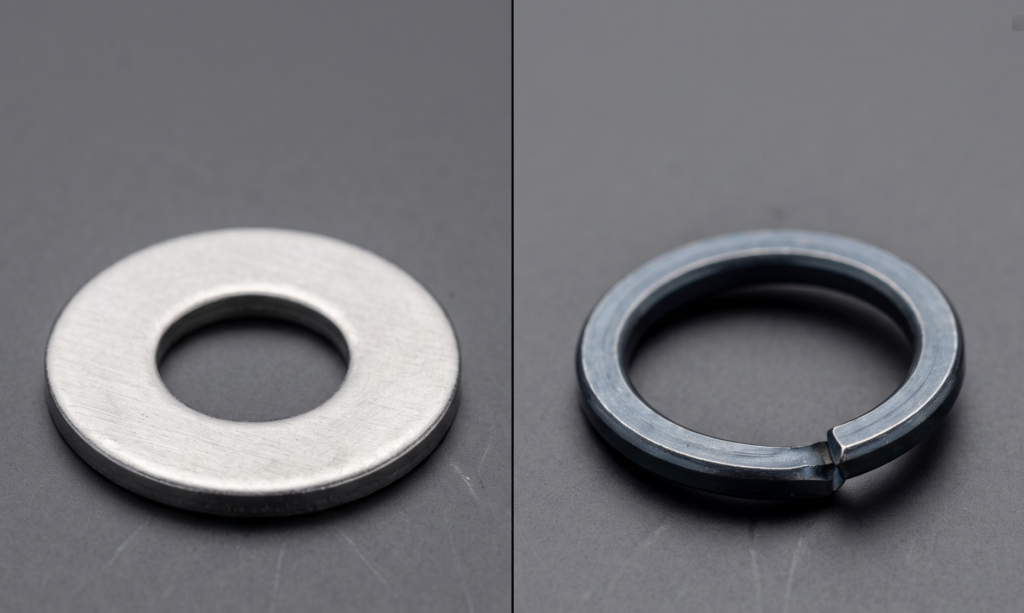
A flat washer is exactly what its name suggests: a flat, disc shaped fastener component placed between a bolt head or nut and the surface of your workpiece. It is completely flat on both sides, with no coils, teeth, or springing action of any kind. Its job is passive by design. As you tighten the bolt, the flat washer spreads that clamping load across a wider surface area instead of letting it concentrate under the bolt head or nut alone.
That load distribution does two things for your assembly. It reduces the pressure on any single point of contact, which helps prevent denting, galling, or crushing on softer materials. And it bridges gaps in oversized or slotted holes, giving the fastener a full bearing surface to sit against even when the hole is larger than the bolt shank. Flat washers are commonly made from stainless steel, high carbon steel, brass, and copper, so you can match the washer material to the corrosion resistance and strength requirements of the application. BoltCraft stocks a full range of flat washers, including SAE and USS profiles in multiple finishes, so you can match the exact spec your assembly calls for.
What Is a Lock Washer?
A lock washer, also called a split washer, takes a different approach. Instead of a flat surface, it is manufactured with a helical or coiled shape that creates spring tension between the bolt head and the mounting surface. The design intent is straightforward: that spring force is supposed to keep constant pressure on the joint and resist the bolt backing itself loose over time.
How Lock Washers Are Supposed to Work
Once a bolt is fully torqued down, the split or helical shape of the washer compresses and applies continuous spring force against the underside of the bolt head or nut. In theory, that ongoing tension resists the small rotational movements that lead to loosening under vibration or thermal cycling. There are two common subtypes you will run into. Split, or helical spring, lock washers rely purely on that spring action. Toothed, or serrated, lock washers add teeth around the inside or outside diameter that bite into the surface for extra grip. That biting action does add mechanical resistance to rotation, but it comes at a cost: serrated washers can mar or scratch finished surfaces, which makes them a poor choice anywhere appearance or coating integrity matters.
Do Lock Washers Actually Prevent Loosening?
This is where the conversation gets more nuanced than most fastener guides let on, and it is worth addressing directly. Lock washers have specialized designs intended to create tension or friction that resists loosening, but a significant body of testing has raised real questions about how well that theory holds up once a bolt reaches full clamping tension. Multiple independent studies, including widely referenced NASA style vibration testing, have found that split lock washers provide little to no measurable resistance to loosening once the bolt is properly torqued. NASA advises against using split lock washers in critical applications for exactly this reason, and some engineers have found that lock washers become largely ineffective beyond roughly 10 ft-lbs of torque, which covers the majority of structural and heavy equipment fasteners.
That testing carried enough weight that lock washers were removed from the DIN 127 standard in the early 2000s. Modern designs often prefer more reliable alternatives to split lock washers for exactly this reason, and you will see fewer lock washer callouts on current engineering drawings than you would have found a generation ago. This is not a dismissal of the lock washer entirely though. It still has a role in lower torque or non critical assemblies, and understanding its actual limits helps you make a better decision than simply defaulting to whatever your last supplier shipped.
When a Flat Washer Is the Right Choice
A flat washer earns its place in almost every well built assembly, and there are several situations where it is clearly the right call.
- Distributing load over soft or thin materials, such as sheet metal panels or wood components, where concentrated pressure would otherwise dent or crush the surface
- Protecting painted or finished surfaces on equipment housings, brackets, and structural panels from scarring during installation
- Bridging oversized or slotted mounting holes on agricultural equipment where field tolerances are wider than standard bolt patterns, a common job for USS flat washers
- General purpose assembly across industrial and construction hardware where vibration is not the primary failure mode
- Automotive and heavy equipment assemblies where consistent, even clamp load matters more than added rotational resistance
When a Lock Washer Still Makes Sense
None of this means the lock washer belongs in the scrap pile. There are still real, defensible reasons to specify one.
Legacy equipment maintenance is one of the most common. If a machine was originally built with lock washers called out on the drawing, matching that existing specification keeps the assembly consistent and avoids introducing an unplanned variable into a proven design. Lock washers also still show up in low vibration or low torque assemblies, light duty consumer hardware, and applications where a customer’s engineering spec simply requires them regardless of what independent testing shows. The point here is not that lock washers are a reliable standalone locking solution. It is that matching existing specifications is often the right business decision, even when the underlying engineering case for the part is mixed.
Worth noting too, lock washers are commonly used in aviation applications and other high vibration environments where they are typically paired with additional locking methods rather than relied on alone, and lock washers can be used together with flat washers when a design calls for both load distribution and added surface friction in a single stack.
Better Alternatives When Vibration Resistance Actually Matters
If vibration resistance is the actual goal of your fastener stack, there are options that outperform a lock washer on their own, and OEMs and fabricators should have these on their shortlist.
Thread locking adhesives, such as Loctite, fill the microscopic gaps between mating threads and cure into a semi rigid bond that resists loosening from vibration without relying on spring tension at all. Prevailing torque lock nuts, often called nylon insert lock nuts, use a deformed thread or nylon collar to create continuous friction along the entire thread engagement rather than a single point of contact. Wedge locking washer systems use two washers with cammed ramps on their mating faces, so any attempt at rotation actually increases clamp tension instead of releasing it. And in every case, correct torque specification remains the single most important defense against a bolt backing out, since lock washers can fail if they are over tightened beyond their springing force, just as an under torqued joint fails for the opposite reason.
Choosing the Right Washer for Your Application
The right washer choice always comes back to what your joint actually needs to do, not which part happens to be sitting on the shelf. If you are protecting a finished surface or bridging an oversized hole on agricultural equipment, a flat washer installed correctly will outperform a lock washer every time. If you are matching an existing spec on legacy machinery or working within a low torque assembly, a lock washer still has a defensible place. And if vibration resistance is the real requirement, pairing correct torque with thread locking compounds or prevailing torque fasteners will give you a far more predictable result than tension alone.
BoltCraft manufactures and supplies both flat washers and lock washers, along with custom washer solutions built to your exact specifications, for agricultural OEM, industrial, automotive, and heavy duty construction customers across the USA. With quick quote turnaround, flexible stock and release programs, and a 100% OEM satisfaction guarantee, you get the right part the first time instead of guessing your way through a parts catalog.
Frequently Asked Questions
Can you use a flat washer and lock washer together?
Yes, stacking a flat washer under a lock washer is common practice. The flat washer protects the surface and distributes load, while the lock washer adds friction on top of it.
Do lock washers work on stainless steel bolts?
Lock washers can be installed with stainless steel bolts, but stainless steel lock washers should be used to avoid galvanic corrosion between dissimilar metals.
What is the difference between a lock washer and a wave washer?
A lock washer uses a split or helical shape to create spring tension against rotation, while a wave washer uses a wavy profile primarily to absorb axial movement and take up slack in an assembly.
Are flat washers required by code on every bolted connection?
No, flat washers are not universally required. They are specified when load distribution, surface protection, or oversized hole bridging is needed for the specific application.
Get the Right Washers for Your Build
Whether your project calls for standard flat washers, lock washers, or a fully custom washer solution, BoltCraft has the manufacturing capability and fastener expertise to deliver exactly what your assembly requires. Browse our full washer selection or request a quote today, and get the fast lead times and 100% OEM satisfaction guarantee that agricultural, industrial, automotive, and construction customers have relied on for decades.