Both flange bolts and hex bolts appear throughout industrial, agricultural, and heavy equipment assemblies, but they are engineered for different performance requirements and joint conditions. Selecting the wrong fastener can result in connection failure, accelerated surface wear, or costly maintenance between service intervals. Understanding the structural and functional differences between these two fastener types helps you make the right call at the design and procurement stage. BoltCraft manufactures both hex cap screws and flange cap screws, and works directly with OEM customers to match the right fastener to their specific assembly needs.
Flange Bolt vs Hex Bolt: A Quick Comparison
The table below summarizes the core engineering differences between hex bolts and flange bolts across the factors that matter most in industrial and OEM applications.
| Factor | Hex Bolt | Flange Bolt |
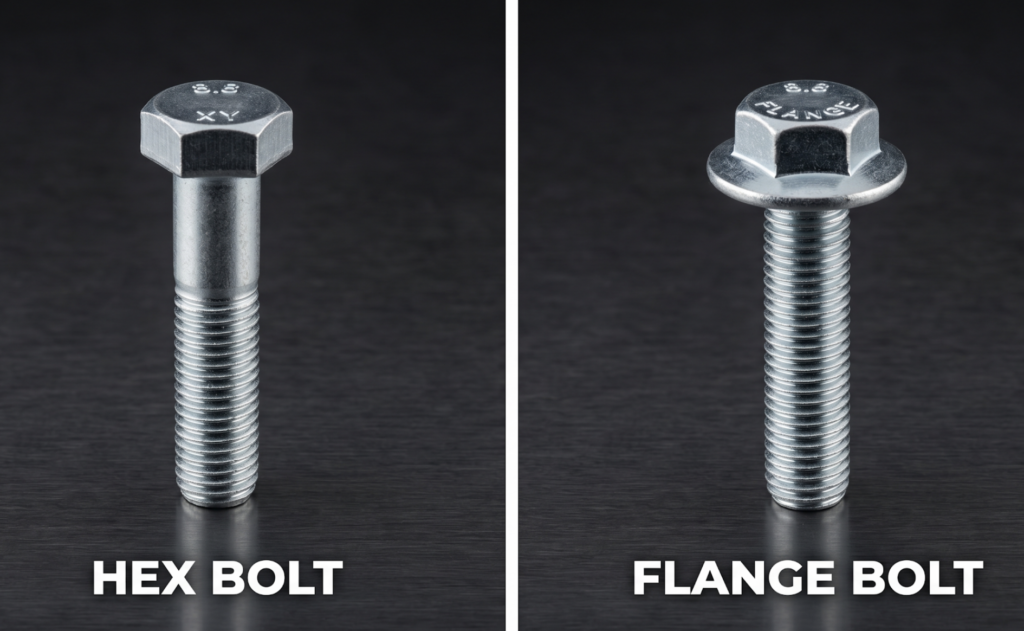
| Head Design | Six-sided head, no integrated washer | Six-sided head with built-in circular flange |
| Bearing Surface Area | Limited to bolt head diameter | Expanded by integrated flange |
| Washer Required | Typically yes | No, flange serves as integrated washer |
| Torque Consistency | Variable due to washer friction interface | More consistent; no rotating washer |
| Vibration Resistance | Requires locking nut or spring washer | Serrated flange provides mechanical lock |
| Assembly Speed | Slower; two components per point | Faster; single component per point |
| Part Count | Bolt plus washer (plus nut if needed) | Bolt only (plus nut if needed) |
| Typical Applications | Structural steel, heavy machinery, agricultural implements | Automotive, heavy equipment, fluid systems, vibration environments |
What Is a Hex Bolt?
A hex bolt is a standard fastener defined by its six-sided head, which is driven by a wrench or socket and paired with a separate nut and, in most applications, a flat washer. The fastener consists of three main sections: the hexagonal head, a shank, and a threaded portion that can run either partially or fully along the length. Hex bolts are available in carbon steel, alloy steel, and stainless steel, with galvanized coatings offered for corrosion resistance in outdoor or humid environments. Grade markings on inch fasteners, including Grade 2, Grade 5, and Grade 8, indicate tensile strength and are standardized across SAE and ASTM specifications.
What Is a Flange Bolt?
A flange bolt is a hex bolt with a wide circular flange built directly into the underside of the head, functioning as an integrated washer without requiring a separate component. The flange distributes clamping force across a larger bearing surface, which reduces localized pressure on the mating material. Flange bolts are available in two primary configurations: smooth flange and serrated flange. The serrated version features teeth along the underside of the flange that bite into the joint surface and resist loosening under vibration, providing a mechanical locking action without additional hardware.
Hex Bolt vs Flange Bolt: Key Design Differences
Although both fastener types share a hexagonal head and use the same installation tools, the built-in flange fundamentally changes how each bolt performs under load, vibration, and torque. The differences below directly affect material selection, assembly speed, and the long-term integrity of the joint.
Head Design and Bearing Surface
A hex bolt carries a standard six-sided head with a relatively limited bearing surface, which is why a flat washer is typically required to spread clamping force and protect the mating surface from damage. A flange bolt eliminates this dependency because the integrated flange significantly increases contact area between the bolt head and the joint. In softer materials like aluminum, this difference in head design can reduce surface pressure by 30 to 40 percent, preventing the bolt head from embedding into the material under high torque. This makes the flange bolt a better choice anywhere surface protection and load distribution matter.
Torque Consistency and Friction Control
When you tighten a hex bolt with a separate washer, there is an additional friction interface between the bolt head and the washer that can cause inconsistency in how the bolt seats. A flange bolt removes that variable because the flange is fixed and does not rotate independently during tightening, which improves torque-to-preload accuracy. This consistency matters on automated production lines and in precision assemblies where repeatable clamping force is critical. For materials prone to galling, such as stainless steel, eliminating that extra interface reduces the risk of damage during installation.
Vibration Resistance
Standard hex bolts rely on spring washers or locking nuts to resist loosening in vibration-heavy environments, but spring washers can flatten out over time and lose their grip, allowing the bolt to back out. Serrated flange bolts address this directly by mechanically engaging the joint surface, maintaining clamping force without requiring supplemental locking hardware. This makes serrated flange bolts the preferred choice for engine mounts, generator sets, heavy equipment frames, and agricultural machinery operating under continuous vibration. The serrations provide a reliable locking mechanism that holds up across service intervals where hex bolt assemblies with worn spring washers would begin to loosen.
Assembly Speed and BOM Complexity
Because flange bolts do not require a separate washer, they reduce part count and simplify the bill of materials for your production program. This speeds up assembly time in high-volume environments and eliminates the risk of missing or improperly installed washers at the line level. A hex bolt requires the assembler to manage two components per fastening point, which adds time and increases the chance of error at scale. For OEM customers running high-volume production, the reduction in hardware count can lower total assembly cost in a measurable way.
Common Uses for Hex Bolts
Hex bolts remain the standard choice for applications where precise torque specifications, broad size availability, and familiar installation tools are required. BoltCraft supplies hex cap screws in a full range of grades and materials for the industries described below.
Structural Steel and Construction
Hex bolts are the dominant fastener in structural steel framing, beam-to-column connections, and heavy civil construction because their strength grades align directly with ASTM structural standards. Pairing them with hardened flat washers ensures proper load distribution across bolted connections, which is a code requirement in many structural applications. The broad diameter and length range available in hex bolts makes them suitable across virtually any structural connection detail.
Heavy Machinery and Industrial Equipment
In machine assembly, press frames, conveyor systems, and industrial equipment, high-strength fastening with precise torque requirements is the priority. The wide availability of hex bolts in Grade 5 and Grade 8 makes it straightforward to specify the right fastener across a full range of load requirements. These grades are well-established in the fastener industry and accepted under international standards, making procurement and replacement easy throughout the service life of the equipment.
Agricultural OEM Equipment
Hex bolts appear throughout planter frames, tillage equipment, and implement attachment points where bolt-and-washer assemblies allow for field serviceability and straightforward replacement by operators and technicians. The combination of broad size availability and familiar installation with standard hand tools makes hex bolts a practical choice wherever field repairability matters. BoltCraft serves agricultural OEM manufacturers with custom hex fastener programs, including stock and release services that keep your production supply consistent.
Common Uses for Flange Bolts
Flange bolts are the preferred fastener wherever vibration resistance, surface protection, and faster assembly are priorities. BoltCraft manufactures flange cap screws as part of its OEM fastener programs across the industries below.
Automotive and Powertrain Assembly
Flange bolts are standard in automotive manufacturing for engine components, transmission housings, exhaust systems, and suspension brackets where vibration is constant and surface protection matters. The integrated flange protects aluminum housings from damage under high torque and maintains consistent clamping force through engine vibration cycles without additional locking hardware. Serrated flange bolts are especially common in powertrain applications because the serrations grip the mating surface and resist loosening even as thermal cycling causes minor dimensional changes in the joint.
Heavy Equipment and Off-Road Machinery
Equipment operating under continuous vibration, including skid steers, excavators, tractors, and material handling machines, benefits from the flange bolt’s built-in locking and load-spreading characteristics. The flange distributes load across larger structural panels, reducing the risk of fasteners backing out between service intervals on machines that spend extended time in rough terrain. BoltCraft supplies flange fasteners to customers in the construction equipment and agricultural OEM space with custom manufacturing and flexible stock programs.
Pipe Flanges and Fluid Systems
In pipeline and fluid transfer applications, flange bolts provide a consistent seal load across the gasket surface, which is critical for maintaining leak-free connections under pressure. The wider bearing surface helps achieve uniform pressure distribution around the flange face, reducing the chance of uneven gasket compression that leads to seepage. This makes flange bolts well-suited for industrial fluid systems, hydraulic manifolds, and process equipment where connection stability directly affects system performance.
When to Choose a Hex Bolt Over a Flange Bolt
Despite the advantages flange bolts offer in vibration and surface protection, hex bolts are the better choice in several specific scenarios. Flange bolts are not produced in as many diameters, lengths, and thread configurations as hex bolts, so when a large size range is required, the hex bolt gives you more options. Structural bolting governed by ASTM A325 or A490 specifications explicitly requires hex head bolts paired with hardened washers, making substitution with flange bolts non-compliant regardless of the strength grade. When a joint requires a hardened washer for a specific load-spreading application, or when cost is a primary concern for high-volume non-critical assemblies, the hex bolt paired with a standard flat washer remains the practical and cost-effective choice.
When to Choose a Flange Bolt Over a Hex Bolt
Flange bolts outperform hex bolts in several well-defined scenarios that come up regularly in OEM and industrial production. In high-vibration environments where self-locking is needed without adding locking hardware to the BOM, serrated flange bolts are the right fastener because they maintain grip through mechanical engagement rather than depending on a separate component. In soft or thin base materials like aluminum or thin sheet metal, the flange eliminates the surface damage that a standard hex head can cause under torque, making it a better fit for any assembly where the joint material is susceptible to compression. On automated production lines where reducing part count and cycle time directly affect cost, the single-component nature of the flange bolt delivers real efficiency gains, and for higher-strength metric grades such as 10.9 and 12.9 where consistent preload is critical, the improved torque-to-clamp relationship of a fixed flange improves joint reliability across the assembly.
Flange Bolt and Hex Bolt Materials and Coatings
Both bolt types are available in similar material grades and surface treatments, and the right combination depends on your operating environment and load requirements. Carbon steel is the most common base material, available in Grade 5 and Grade 8 for inch fasteners and 8.8, 10.9, and 12.9 for metric fasteners, covering the majority of industrial and OEM applications. Stainless steel is the choice where corrosion resistance is the primary concern, while alloy steel is used in high-strength applications where tensile requirements exceed standard carbon steel grades. Common coating options include zinc plating for general indoor and mild outdoor service, hot-dip galvanizing for heavy outdoor or moisture-exposed environments, and mechanical zinc for applications requiring uniform coating thickness on threaded fasteners. BoltCraft can supply both fastener types in custom material and coating combinations tailored to your OEM program specifications.
Frequently Asked Questions About Flange Bolts and Hex Bolts
Do flange bolts need a washer?
In most cases, no. The integrated flange functions as a built-in washer and eliminates the need for a separate washer in standard applications. Adding a washer under a flange bolt can actually reduce joint stability by introducing an extra friction interface between the flange and the washer during tightening. In situations involving very delicate surfaces or extreme vibration environments, a supplemental washer may be warranted, but this is the exception rather than the rule.
Are flange bolts and hex bolts interchangeable?
They share the same thread dimensions and can be swapped in terms of thread size and length, but there are important considerations before doing so. Replacing a flange bolt with a hex bolt requires adding a washer to replicate the original clamping surface area and prevent surface damage. Replacing a hex bolt with a flange bolt requires confirming that sufficient clearance exists for the larger-diameter flange head, particularly in tight or countersunk assemblies where the extra diameter may not fit.
Which bolt is stronger, a hex bolt or a flange bolt?
Strength is determined by the material grade of the bolt, not the head style. A Grade 8 hex bolt and a Grade 8 flange bolt carry the same tensile strength rating. However, in high-vibration environments, a serrated flange bolt may outperform a hex bolt with a spring washer over time because it maintains consistent clamping force through mechanical engagement rather than relying on a separate component that can lose tension.
Can flange bolts be used in structural applications?
Flange bolts are generally not specified for structural steel connections governed by ASTM or AISC standards, which require hex head bolts paired with hardened washers under standards like A325 or A490. For non-structural assemblies in heavy equipment frames, machine housings, and agricultural implements, flange bolts are a well-suited and practical choice. Always verify the applicable specification before substituting fastener types in any engineered assembly.
What industries use flange bolts most often?
Flange bolts are most common in automotive manufacturing, agricultural equipment OEM production, construction equipment assembly, and industrial machinery. They are also widely used in pipeline and fluid system connections where even gasket loading and seal stability are important. BoltCraft supplies flange fasteners across all of these industries with custom manufacturing options and stock and release programs tailored to OEM production schedules.
BoltCraft Supplies Both Hex Bolts and Flange Bolts for OEM Applications
Whether your application calls for a hex cap screw or a flange cap screw, BoltCraft manufactures both to precise OEM specifications with fast lead times, bulk pricing, and flexible stock and release programs designed to keep your production line moving. BoltCraft serves agricultural OEM, industrial, automotive, and heavy-duty construction customers across the USA with custom fastener solutions backed by a 100% OEM satisfaction guarantee. If you are evaluating the right fastener for your next assembly or looking to consolidate your fastener supply with a single trusted manufacturer, request a quote or contact us directly to discuss your requirements.